Foot drop is not a disease. It is a walking problem. Your foot cannot lift properly when you walk, so your toes drag, you trip, and you have to lift your knee higher to clear the ground. It happens after stroke, multiple sclerosis, nerve injury, or spinal cord issues.
For years, the solution was simple: an Ankle Foot Orthosis (AFO). Now there is a smarter option: FES – Functional Electrical Stimulation. Which one is better for restoring gait? Let’s compare.
What is AFO?
An AFO is a brace, usually made of plastic, that holds your foot at 90 degrees. It mechanically prevents the foot from dropping.
Pros:
– Cheap and only give you support while wakling.
– Very reliable, no charging or wires
– Good for immediate stability
Cons:
– It holds the muscle, so the muscle becomes weaker over time
– Bulky inside shoes, can cause pressure sores
– It does not train the brain, it just compensates
– Limits ankle movement, so gait looks robotic
What is FES?
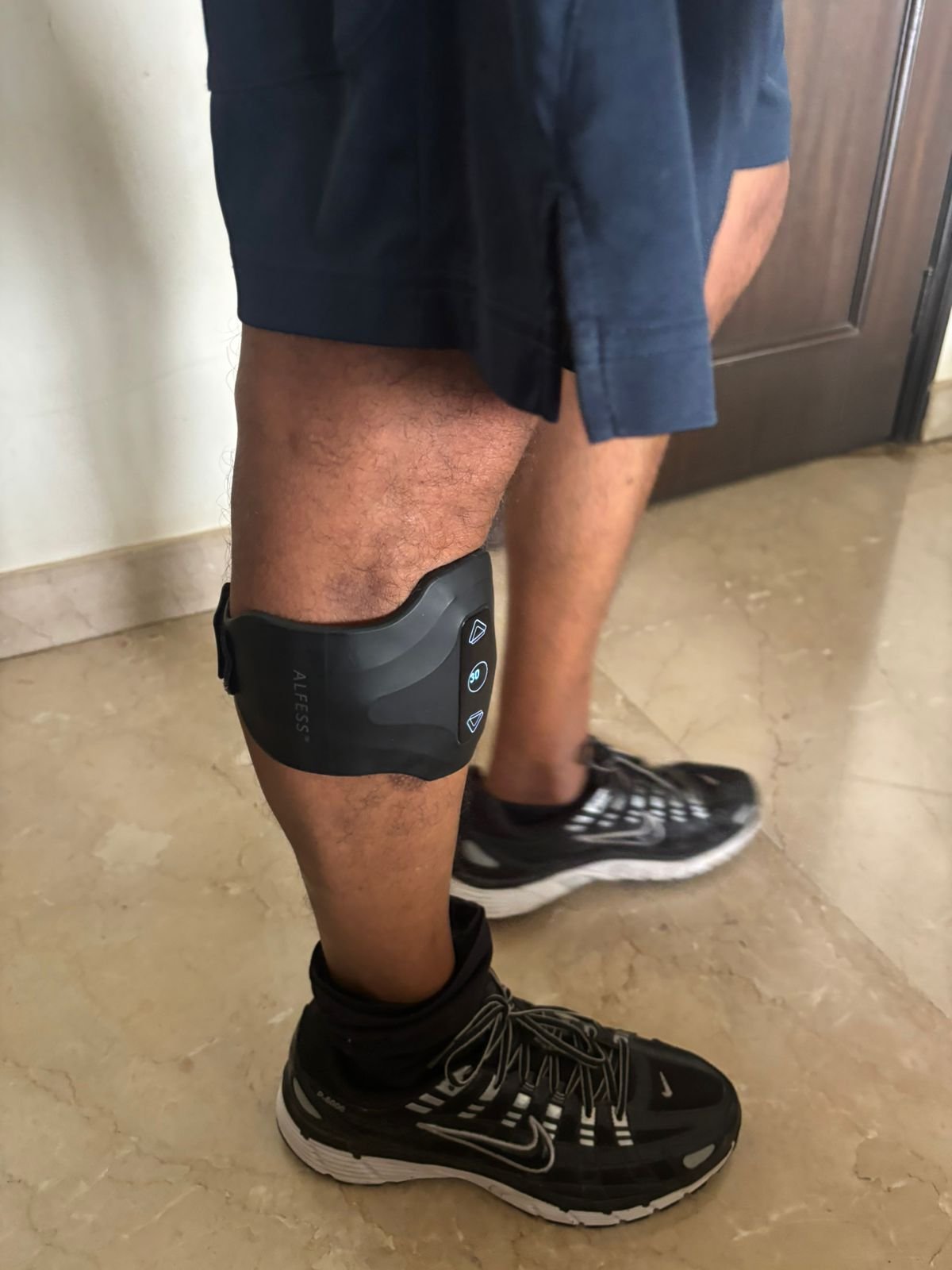
FES is a small device, It has a sensor and electrodes. When your leg goes into swing phase, it gives a mild electrical pulse to the peroneal nerve. That pulse lifts your foot naturally.
Pros:
– Lifts the foot using your own muscle
– Prevents muscle wasting
– Improves neuroplasticity – with long-term use, some patients start lifting the foot even without the device
– More natural gait, faster walking speed, less effort
– You can wear it barefoot
Cons:
– Cost is higher than AFO
– Needs daily charging and proper skin care
– Not suitable if nerve is completely damaged or if you have pacemaker/epilepsy
– Needs correct electrode placement
FES vs AFO: Head-to-Head
| topic | AFO | FES |
| Gait pattern | Stiff ankle natural | Near- normal ankle movement |
| Muscle strength | Decreases over time | Improve and maintains |
| Brain recovery | No training effect | Trains brain for recovery |
| comfort | Can be uncomfortable ,sweaty | Lightweight but tingling sensation |
| Long term goal | Compensation only | Rehabilitation and recovery |
Research says: Both improve safety and reduce falls. But studies published in Stroke and Neurorehabilitation journals show FES gives better improvement in walking speed, confidence, and quality of life after 3-6 months of use compared to AFO alone.
Which One Should You Choose?
It’s not FES vs AFO for everyone.
Choose AFO if:-You need a low-cost, maintenance-free solution, or your nerve is completely non-responsive.
Choose FES if:-You have stroke/MS/incomplete SCI, your peroneal nerve still responds to stimulation, and your goal is not just walking but recovering.
Many clinics now start with AFO in early stage, then shift to FES for long-term rehabilitation along with physiotherapy.
AFO stops the foot from dropping. FES teaches the foot to lift again.
If your goal is just to not trip today, AFO is enough. If your goal is to restore gait and get your own muscle working again, FES is the better rehabilitation tool.
What ideal artificial limb solutions gives you ?
We gives you free trail of FES.
Prosthetist and orthotist will understand your problem and gives you best solution
We understand your root cause and work on it
Regular every month free follow-up with patient.