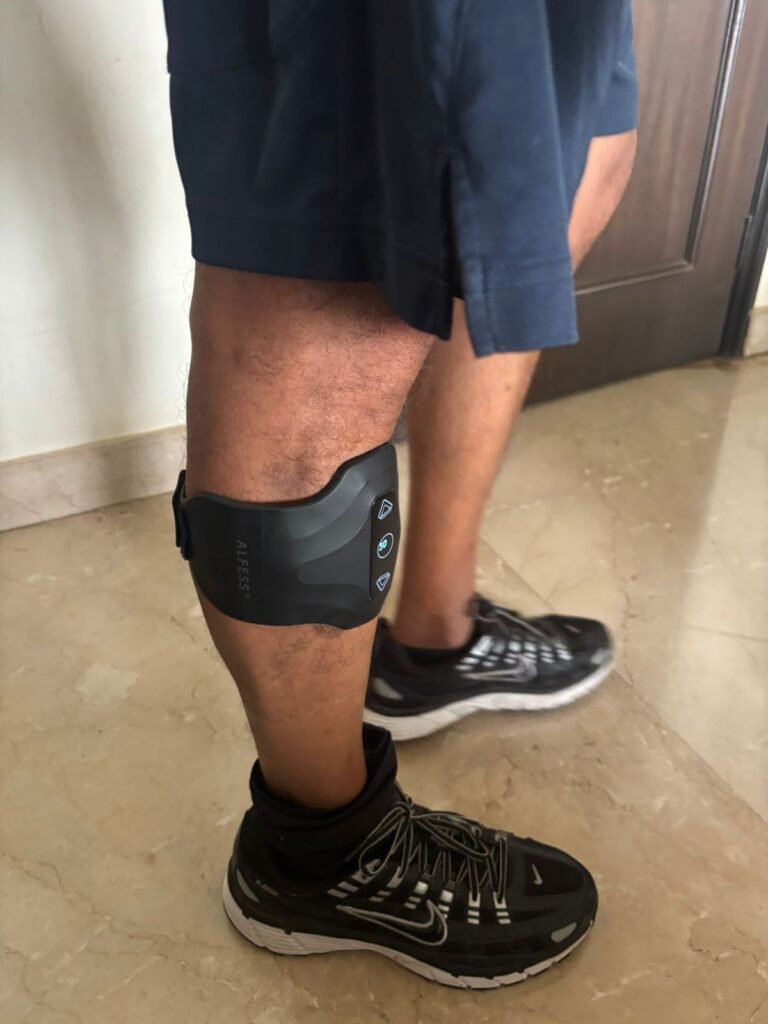
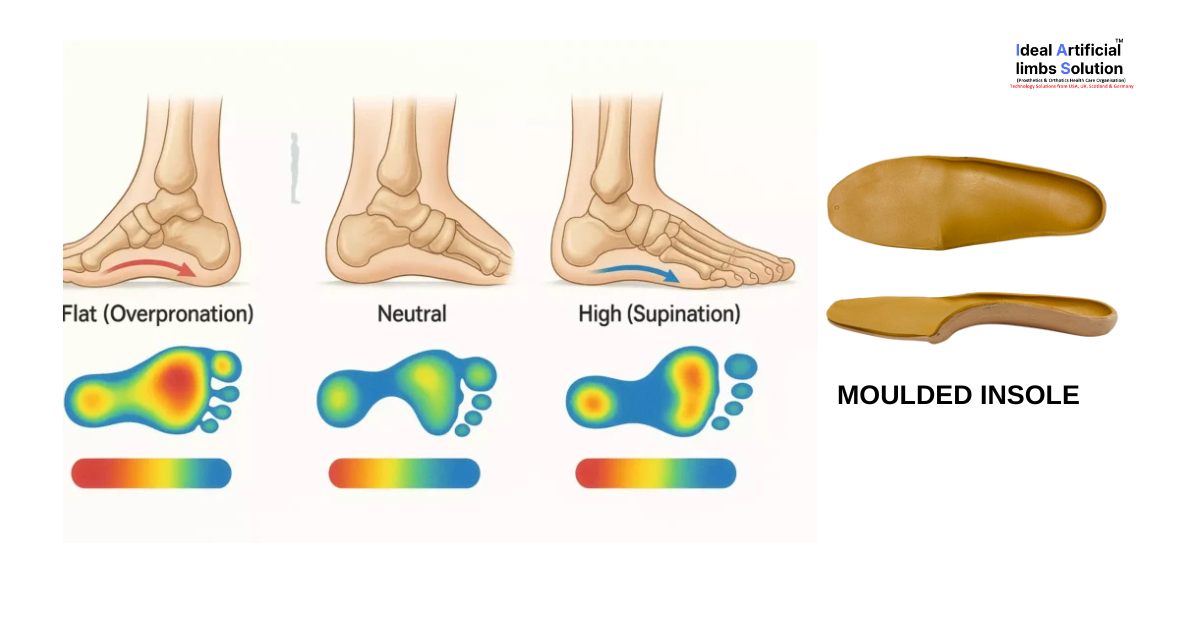
Every person walks differently. This unique way of walking is called your gait pattern. Your gait decides how your feet, knees, hips, and back bear weight with every step. If your gait is imbalanced due to flat feet, high arches, overpronation, or poor posture — it creates extra pressure on certain points. Over time this leads to heel pain, knee pain, back pain, and fatigue. Generic shoe inserts cannot fix this because they are not made for your feet. That’s where personalized customized insoles come in.
After a proper gait analysis, we study your foot pressure, arch type, and walking style. Then ideal artificial limb solution design insoles that are made only for you. These insoles correct imbalance, support your arch, and distribute weight evenly.
WHY PERSONALISED INSOLES GIVES YOU BETTER RESULT THAN GENERIC INSOLE.
1. Corrects Abnormal Foot Pronation/Supination
Clinical Reason:- Most gait problems come from overpronation – foot rolls inward too much – or over supination – foot rolls outward.
Generic Insole:- Has flat/neutral arch. It can’t control motion. So stress keeps going to ankle, knee & hip.
Personalized Insole:- Built with specific medial/lateral posting based on your gait analysis. It controls and guides the foot back to neutral position.
Result:- Reduces strain on plantar fascia, IT band, knees and prevents injuries like shin splints & runner’s knee.
2. Redistributes Plantar Pressure Points
Clinical Reason:- During walking, some areas of your foot take 3x more pressure. High pressure = pain, callus, ulcers.
Generic Insole:- Same cushion everywhere. So pressure points remain high.
Personalized Insole:- Made from your pressure mapping + gait scan. It adds cushioning under high-pressure areas and support under low-pressure areas.
Result:- Prevents plantar fasciitis, metatarsalgia, diabetic foot ulcers. Pain reduces immediately.
3. Improves Lower Limb & Spinal Alignment
Clinical Reason:- Your foot is the foundation. If foot collapses or tilts, it creates a chain reaction: ankle → knee valgus/varus → hip tilt → lower back pain.
Generic Insole:- Does not correct alignment. It just adds softness.
Personalized Insole:- Corrects mid foot and hindfoot alignment and arch collapse. This brings knee, pelvis and spine back to neutral biomechanics.
Result:- Clinical reduction in knee OA pain, hip pain, and chronic low back pain.
4. Enhances Shock Absorption & Energy Efficiency.
Clinical Reason:- With every step your body absorbs 2-3x your body weight. Wrong gait wastes energy and increases joint impact.
Generic Insole – Generic foam compresses quickly and loses support.
Personalized Insole:- Designed with dual-density materials + arch contour specific to your weight and gait cycle. It absorbs shock at heel strike and gives propulsion at toe-off.
IS INSOLE FOR ONLY FLAT FOOT , OVERPRONATION , HIGH ARCH FOOT PATIENT ?
No it’s a myth . insoles not solve only flat feet , cavus feet problem .its solve so many hidden problem in your feet. Now lets talk about it one by one . insole are given to flat foot , cavusfeet , overpronation , supinated feet , hammer toe , metatarsalgia , Morton neuroma , osteoarthritis, limb length discrepancy , back pain , ulcer .
From Scan to Solution: How Gait & Foot Pressure Mapping Creates Personalized Insoles.
1: The Scan – Capture Your Unique Footprint*
Using a *3D Foot Scanner*, we take a digital model of your foot in both standing and walking positions.
*What we measure:* Arch height, foot width, toe alignment, and structural deformities.
Why it matters: No two feet are identical. This scan becomes the blueprint for your insole.
2: Pressure Mapping – See Where Pain Begins*
You walk on a *Dynamic Pressure Plate* with 2000+ sensors.
*What we measure:* Where your foot hits hardest. We get a “heat map” – Red = high pressure, Blue = low pressure.
*Why it matters:* This finds the root cause of plantar fasciitis, callus, metatarsal pain, and diabetic ulcers before they get worse. Now we know exactly where to add cushion and support.
3: Gait Analysis – Understand Your Movement
Our system records your full walking cycle: heel strike → midstance → toe-off.
What we measure:- Pronation angle, walking speed, weight distribution, leg alignment.
Why it matters:- 70% of knee, hip, and back pain starts from the foot. If you overpronate or walk unevenly, we add corrective posting to bring your body back to neutral alignment.
Step 4: The Solution – CAD/CAM Custom Fabrication
All your scan, pressure, and gait data is fed into design software.
A biomechanical engineer then designs your insole with:
1. *Custom Arch Support* – built to your exact arch
2. *Targeted Cushioning* – at your high-pressure zones
3. *Corrective Elements* – wedges to control pronation/supination
Types of Materials Used in Customized Insoles
Not all insoles are made the same. The material decides *comfort, support, durability, and who it’s for.
After your scan, we choose materials based on your *weight, activity level, gait problem, and diagnosis.
1. EVA Foam – Ethylene Vinyl Acetate
Best for:- Daily wear, shock absorption, mild to moderate pain
Feel:- Soft, cushy, lightweight
Clinical Use:- Plantar fasciitis, heel pain, people who stand 6-8 hrs
Pros:- Great shock absorption, affordable, comfortable
Cons:- Compresses over 8-12 months with heavy use
2. Polypropylene / Polyethylene – Semi-Rigid Shell
Best for:- Biomechanical correction, sports, active people
Feel:- Firm but has some flex
Clinical Use:- overpronation, flat feet, knee pain, runners, athletes
Pros:- Controls motion, durable 2-3 years, gives realignment
Cons:- Needs 1-2 week break-in period
3. Carbon Fiber – Rigid Shell*
Best for:- Maximum support, severe alignment issues, athletes
Feel:- Very stiff, lightweight, doesn’t bend
Clinical Use:- Severe overpronation, post-surgery, arthritis, turf toe, sports performance
Pros:- Ultra durable 3-5 years, best motion control, energy return
Cons:- Less cushioning, expensive
4. Poron / Memory Foam / PPT – Top Cover Cushioning
Best for:- Pressure relief, diabetic patients, elderly
Feel: – Soft, slow-rebound, like memory foam
Clinical Use:- Diabetic foot, metatarsalgia, ulcers, high pressure points
Pros:- Redistributes pressure, protects sensitive feet
Cons:- By itself it’s too soft. Used as top layer over a shell
5. Cork / Leather – Natural & Mouldable*
*Best for:* Comfort + support balance, dress shoes, long-term wear
*Feel:* Firm, Molds to your foot over time
*Clinical Use:* Mild flat feet, high arches, professionals who wear formal shoes
*Pros:* Breathable, anti-Odor, Molds to foot, lasts 2+ years *Cons:* Heavier, needs break-in